这个男人来自地球
书名:打架成本警示牌|作者:笑无语|本书类别:古言|更新时间:11:45:28|字数:3896字
A |
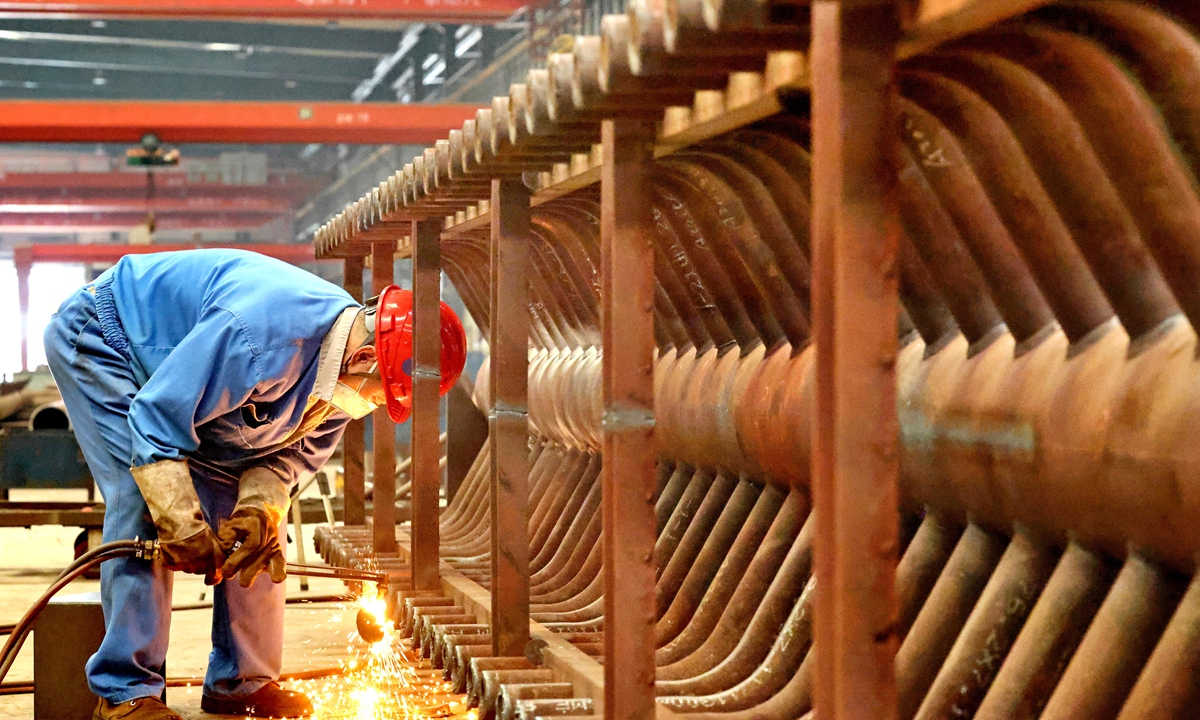
But what are the facts on the ground?
China's Ministry of Commerce recently released a document titled China's Position on the So-Called Excess Capacity Issue. Reviewing the evolution of the global capacity landscape from a historical perspective, it offers an objective analysis of how industrial subsidies, trade surpluses, economic imbalances and market competition relate to "overcapacity," sets out China's policy practices and the direction of its efforts, and puts forward China's ideas and proposals - a forceful response to the "China overcapacity" narrative.
Plainly, the argument that "China's inadequate domestic demand gives rise to excess capacity" rests on a logical sleight of hand - it takes a localized phenomenon at the micro level of the market and applies it wholesale to the structure of the macroeconomy, a picture far removed from reality.
China is not only a major manufacturing power but also a major consuming power. Domestic demand has long been the main engine of the Chinese economy.
To see through the logical fallacy of the "overcapacity" narrative, one must first be clear about where the Chinese economy actually sits in the global landscape.
In the course of economic globalization, China has actively integrated itself into the international division of industrial labor and become the "world's factory" in the truest sense. Chinese manufacturing has enriched the global supply of goods, lowered living costs for consumers in countries around the world, and played an important part in easing global inflationary pressure. But to define China simply as a "producer" on that basis, and from there to conclude that it suffers from "inadequate domestic demand and overcapacity," is a proposition that does not hold water.
From 2013 to 2024, domestic demand contributed an average of 93 percent to China's economic growth, with consumption and investment accounting for an average of 55 percent and 38 percent respectively. China's total retail sales of consumer goods rose from 23.8 trillion yuan ($3.53 trillion) in 2013 to 50.1 trillion yuan in 2025, doubling in size.
Measured at the World Bank's purchasing power parity rates, China's total retail sales of consumer goods in 2025 were 1.7 times those of the US, making the country the world's largest market for consumer goods in all but name. China today ranks first globally in the physical volume of goods consumed, and its per capita annual consumption of some industrial products already approaches the levels seen in developed economies.
China keeps expanding its domestic demand and is working toward a higher-level balance between supply and demand.
Growth in China's total retail sales of consumer goods has slowed somewhat in recent years, and some have taken this as proof of weak domestic demand. That reading is neither objective nor complete.
A strong domestic market provides strategic support for Chinese modernization. The outline of China's 15th Five-Year Plan (2026-30) period devotes a dedicated part to building such a market, stressing the need to adhere to the strategic focus of expanding domestic demand, to expand effective investment, to further implement special actions to boost consumption, to promote the expansion and upgrading of commodity consumption, to unleashing the potential of service consumption, to strengthening the foundation of residents' consumption and to continuously improve the consumption environment - using new demand to guide new supply, and using new supply to create new demand, so as to promote a virtuous cycle between consumption and investment, and between supply and demand, achieve a higher level of dynamic balance between supply and demand.
The slowdown in retail sales growth is consistent with China's shift from high-speed growth to high-quality development, and it also reflects the upgrading of the country's consumption structure. China's consumer market is moving faster from one dominated by goods toward one in which goods and services carry equal weight. Spending on services is growing rapidly and is expected to account for more than half of the total by 2030.
China's super-sized market is not only the bedrock of its own development but also a broad platform on which countries around the world can share in the dividends of that growth.
China has ranked as the world's second-largest importer for 17 consecutive years and is a major export destination for nearly 80 countries and regions. It has granted zero-tariff treatment to 63 countries and regions, becoming the first major economy in the world to extend full zero-tariff coverage to every African country and every least developed country that has diplomatic relations with it. It is also the only country to host an international import expo, having staged eight editions of the China International Import Expo with cumulative intended deals worth more than $580 billion. Over the 14th Five-Year Plan period (2021-25) period, China's cumulative imports topped 90 trillion yuan. These facts and figures show clearly that China is not just the "world's factory" but, still more, the "world's market."
Looking ahead, China's middle-income group is set to exceed 800 million people within little more than a decade, and per capita GDP is expected to reach the level of a moderately developed country. With vast room for consumption and ample potential and vitality, domestic demand will remain the main engine of China's economic development and will keep injecting strong momentum into world economic growth.
This was compiled and translated by the Global Times English edition based on an article published in the "Chisu Jinsheng" economic commentary column of the People's Daily on August 6, 2026.
。 NEW YORK -- Americans showed their steadfast resilience and kept spending online, at restaurants and other outlets in September even as they grappled with higher prices, rising interest rates and a host of other headwinds piling up.Retail sales rose 0.7% in September, more than twice what economists had expected, and close to a revised 0.8% bump in August, the Commerce Department reported Tuesday. Retail sales in August were inflated after gasoline prices spiked, however. That was not the case in September when gas prices rose more slowly.A closely watched category of retail sales that excludes auto dealers, gas stations and building materials and feeds into the gross domestic product jumped 0.6% last month compared to the prior month.Tuesday's sales figures aren't adjusted for inflation, but the cost of goods barely rose last month, so the increased spending isn't a reflection of higher prices. Prices for durable goods, such as those sold by appliance and electronics stores, actually fell last month.The government’s monthly retail sales report offers only a partial look at consumer spending; it doesn’t include many services, including health care, travel and hotel lodging. But it does cover spending at restaurants, which had a solid 0.9% increase. Spending online rose 1.1% last month, according to the report. Sales at general merchandise stores rose 0.4%. Sales at home furnishings and furniture stores were flat, while electronics stores and outlets that sell building materials saw declines reflecting a difficult housing market. The retail sales report, which reflects the sixth consecutive monthly gain, reinforces the fact that American consumers, as a whole, are showing no signs of pulling back on their spending, which powers most of the economy. That spending comes despite attempts by the Federal Reserve to cool spending and hiring. That's good news heading into the critical holiday shopping season. But the robust sales report also means that the Fed officials could leave the door open for additional rate hikes. That means that shoppers could face higher interest rates for awhile.“If the cost-of-living crisis has hit consumer confidence, you wouldn’t know it judging by a second month of strong retail sales with the consumer buying everything that wasn’t nailed down,” said Christopher S. Rupkey, chief economist at FWDBONDS LLC, a financial markets research company. “Fed officials have another rate hike this year up on their forecast board, and they will need to use it, if the economic data continues to surprise economists on the upside.” Still, questions remain whether shoppers will finally buckle under more bad news piling up from federal budget wrangling, the resumption of student loan repayments, and new global tensions tied to the Oct. 7 surprise attack by Hamas in Israel. The moratorium on student loan payments lifted Oct. 1. Analysts say that shoppers could also become rattled if the Israel-Hamas war is not contained.Moreover, the relentless spending by shoppers also comes at a cost to their household finances.“We have repeatedly under-estimated the U.S. consumer, “ said Tim Quinlan, a senior economist at Wells Fargo Economics. ”But in pulling off this spending spree, consumers have dented their household finances, a theme that is evident not only in the diminished savings, but also the trend rise in credit card delinquencies.”Healthy consumer spending is expected to lift the economy's growth rate to about 3.5% or possibly even higher in the July-September quarter. September's strong sales also suggests the economy may not slow as much in the final three months of the year as previously expected, analysts said. The retail sales report came as businesses across the U.S. economy ramped up hiring in September, defying surging interest rates, and the ongoing threat of a government shutdown. The strength of hiring has surprised economists inside and outside of the Fed. Consumer prices rose 0.4% from August to September, below the previous month’s 0.6% pace. The report from the Labor Department also showed that year-over-year inflation was flat last month from a 3.7% rise in August.Meanwhile, retailers are pulling out discounts and other incentives to get shoppers to open their wallets for the holiday season as they worry about shoppers' finances. Best Buy, the nation's largest consumer electronics retailer, unveiled a new experience that gives shoppers a chance to access some of the biggest deals and cool gadgets of the holiday season. The items, which kicked off late last month, are only available in limited quantities and exclusively through the Best Buy app. ——————AP Economics Writer Christopher Rugaber contributed to this report from Washington.——————Follow Anne D’Innocenzio: http://twitter.com/ADInnocenzio。


